Feb 28, 2026
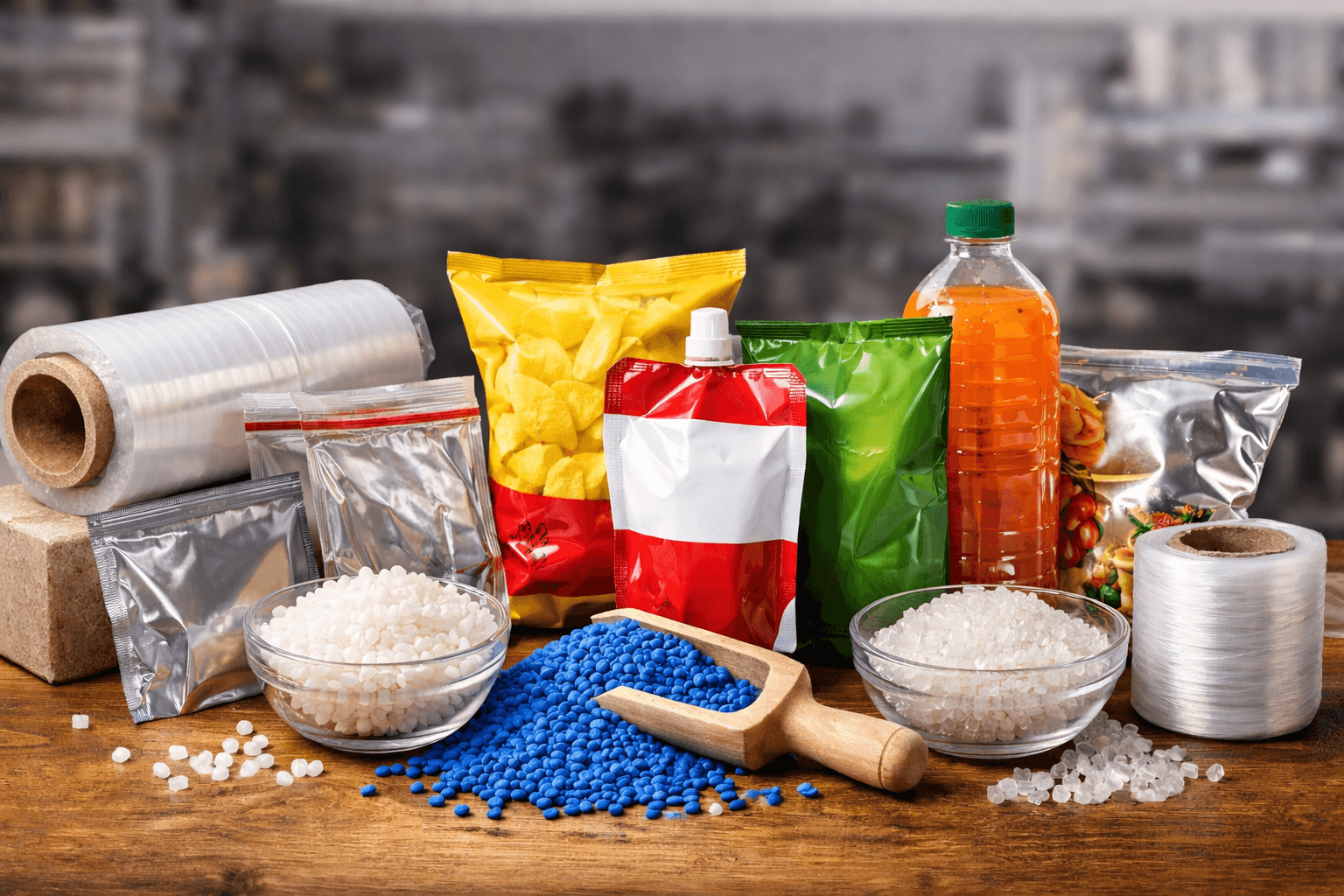
Flexible packaging is a cornerstone of modern product protection and marketing. It refers to any package or part of a package that can easily change its shape. This includes common items like pouches, biscuit packaging, ketchup sachets, laminate tubes, and cling films. For manufacturers and traders in the plastics industry, selecting the right polymer grade for a specific application is a critical decision that impacts everything from product shelf life to production efficiency.
This guide is designed to be a definitive resource for anyone looking to understand which polymer grades are best suited for their flexible packaging needs. We will explore the properties and applications of the most common polymers used in blown and cast film production, helping you make an informed choice for your manufacturing process.
How to Choose the Right Polymer Grade
Choosing the right polymer grade depends on a variety of factors. Here are some key considerations:
Application: What is the end use of the product? Does it need to be strong, flexible, transparent, or have good barrier properties?
Manufacturing Process: What type of processing equipment will be used? Blown film and cast film extrusion have different requirements.
Cost: What is the budget for the material? Prices can vary significantly between different polymer grades.
Regulatory Requirements: Are there any food contact or medical regulations that need to be met?
Comparison of Polymer Grades
Property | LDPE | LLDPE | HDPE | PP TQ |
|---|---|---|---|---|
Flexibility | High | Medium-High | Low | Medium |
Strength | Low | High | Very High | Medium-High |
Transparency | High | Medium | Low | Very High |
Puncture Resistance | Low | High | Medium | Medium |
Heat Resistance | Low | Low | Medium | High |
Cost | Low | Medium | Low-Medium | Medium |
Common Process | Blown Film | Blown Film | Blown Film | Cast Film |
Understanding Polymer Grades for Flexible Packaging
Choosing the right polymer is not just about the material itself. It is about matching the material's properties to the demands of the application and the manufacturing process. Let's dive into the specifics of the most widely used polymer grades in flexible packaging.
LDPE (Low-Density Polyethylene)
What it is: LDPE is a soft, flexible, and lightweight plastic. Its highly branched molecular structure gives it a lower density and makes it more transparent than other polyethylene variants. It is known for its toughness, flexibility, and good resistance to acids, bases, and vegetable oils.
Why it's used: LDPE is a popular choice for its combination of flexibility, transparency, and cost effectiveness. It is particularly well suited for applications where high clarity and easy processing are important. Its ability to be easily sealed makes it a go to material for food packaging.
Manufacturing Process: LDPE is most commonly processed using the blown film extrusion method. It can also be used in cast film extrusion, although this is less common. Its good melt strength makes it easy to process.
Key Properties:
Flexibility: High flexibility, even at low temperatures.
Transparency: Good clarity and gloss.
Moisture Resistance: Excellent barrier to water and moisture.
Chemical Resistance: Good resistance to many chemicals.
Common Applications:
Carry bags and shopping bags
Sugar bags and other food packaging
Stretch films and shrink films
Lamination films
Agricultural films (greenhouse films)
Alternatives: If LDPE is not available, LLDPE can be a suitable alternative, offering improved strength and puncture resistance, though with slightly lower clarity.
Source supplies LDPE blown film grades with MFI ranges from 0.3 to 2.5, ideal for carry bags, food packaging, and agricultural films. Browse current inventory and pricing on the platform.
LLDPE (Linear Low-Density Polyethylene)
What it is: LLDPE is a substantially linear polymer with a significant number of short branches. This structure gives it higher tensile strength and puncture resistance compared to LDPE. It is a very versatile material, often blended with LDPE to improve its properties.
Why it's used: LLDPE is favored for applications that require higher strength and durability than what LDPE can offer. Its excellent elongation properties make it ideal for stretch films, where it can be stretched significantly without breaking.
Manufacturing Process: LLDPE is primarily processed using blown film extrusion. It can also be processed using cast film extrusion. It requires more energy to process than LDPE due to its different rheological properties.
Key Properties:
Strength: High tensile strength and puncture resistance.
Stretchability: Excellent elongation and stretch capabilities.
Durability: Good resistance to environmental stress cracking.
Flexibility: Remains flexible at low temperatures.
Common Applications:
Stretch films for pallet wrapping
Heavy duty bags and sacks
Agricultural films (silage wrap)
Food packaging (frozen food bags)
Liners for tanks and ponds
Alternatives: For applications requiring even higher strength, HDPE can be considered, although it has lower flexibility. Blends of LLDPE and LDPE are also common to achieve a balance of properties.
Source carries LLDPE stretch film and blown film grades (MFI 0.5 to 2.0) for pallet wrap, agricultural films, and heavy-duty packaging. Check availability and specifications for your application.
HDPE (High-Density Polyethylene)
What it is: HDPE is a more rigid and harder polyethylene with a higher density. It has a linear molecular structure with very little branching, which results in a stronger, more crystalline material.
Why it's used: HDPE is chosen for its high strength to density ratio. It is a very versatile plastic that is used in a wide variety of applications, including many that require a strong, stiff material. It is also resistant to many chemicals.
Manufacturing Process: HDPE is typically processed using blown film extrusion. It can also be injection molded and blow molded for other applications.
Key Properties:
Strength: High tensile strength and stiffness.
Impact Resistance: Good impact resistance, even at low temperatures.
Chemical Resistance: Excellent resistance to a wide range of chemicals.
Moisture Resistance: Very low moisture absorption.
Common Applications:
Grocery bags and carry bags
Milk jugs and other bottles
Pipes and fittings
Geomembranes
Toys
Alternatives: For applications requiring more flexibility, LLDPE or LDPE would be better choices. For applications requiring higher temperature resistance, PP might be a suitable alternative.
Source stocks HDPE blown film grades for grocery bags, carry bags, and industrial applications. Explore grade options and request quotes directly on the platform.
PP TQ (Polypropylene Transparent Quality)
What it is: PP TQ is a grade of polypropylene specifically designed for high clarity and transparency. Polypropylene is a thermoplastic polymer known for its strength, stiffness, and resistance to heat and chemicals.
Why it's used: PP TQ is used in applications where both the strength of polypropylene and high transparency are required. It is often used for food packaging where product visibility is important. It is also a good choice for applications that require sterilization, as it can withstand high temperatures.
Manufacturing Process: PP TQ is typically processed using cast film extrusion to achieve the highest clarity. It can also be processed using blown film extrusion.
Key Properties:
Transparency: Excellent clarity and gloss.
Strength: Good tensile strength and stiffness.
Heat Resistance: High melting point, suitable for hot fill applications.
Moisture Barrier: Good barrier to moisture.
Common Applications:
Bakery packaging
Food packaging (biscuits, snacks)
Transparent containers and lids
Medical packaging
Labels
Alternatives: For applications requiring more flexibility, LDPE or LLDPE might be better choices. For applications requiring higher impact strength, impact copolymers of PP could be used.
Source supplies PP TQ cast film and blown film grades for bakery packaging, food packaging, and medical applications. View available grades and technical datasheets on the marketplace.
Frequently Asked Questions (FAQs)
Which polymer is used for biscuit packaging?
Biscuit packaging often requires a combination of properties, including good moisture barrier, strength, and printability. Multilayer films are commonly used, often with a layer of PP for stiffness and printability, and a layer of LDPE or LLDPE for sealing.
What is the difference between blown and cast film?
Blown film is produced by extruding a tube of molten polymer and inflating it with air to create a bubble. This process gives the film good strength in both the machine and transverse directions. Cast film is produced by extruding the molten polymer through a flat die onto a chilled roller. This process gives the film excellent clarity and a smooth surface.
Can I substitute LLDPE for LDPE?
Yes, in many cases, LLDPE can be substituted for LDPE. LLDPE offers improved strength and puncture resistance, which can allow for down gauging (using a thinner film) and cost savings. However, LLDPE is generally less clear than LDPE and may require adjustments to processing conditions.
What should I look for when buying polymer grades?
When buying polymer grades, it is important to consider the melt flow index (MFI), density, and any additives that may be included. The MFI is a measure of how easily the polymer flows when melted and is a key parameter for processing. The density will affect the stiffness and strength of the film. Additives can be used to improve properties such as UV resistance, slip, and anti block.
How do price considerations affect my choice?
Price is always a major factor in material selection. LDPE and HDPE are generally the most cost effective options. LLDPE is slightly more expensive, but its improved properties can sometimes lead to overall cost savings through downgauging. PP TQ is typically more expensive than the polyethylene grades.
Which polymer is best for stretch film?
LLDPE is the preferred material for stretch film due to its excellent elongation and puncture resistance. It can be stretched significantly without breaking, which allows it to hold loads securely on a pallet.
What is a multilayer film?
A multilayer film is a film that is made up of two or more layers of different polymers. This is done to combine the properties of different materials to create a film with a unique set of characteristics. For example, a multilayer film for food packaging might have a layer of EVOH for oxygen barrier, a layer of nylon for puncture resistance, and a layer of PE for sealing.
Are all flexible packaging films recyclable?
No, not all flexible packaging films are recyclable. Monomaterial films, such as those made from only PE or only PP, are more easily recycled. Multilayer films made from different materials can be difficult to recycle. However, there is a growing trend towards designing flexible packaging for recyclability.
What is the difference between a homopolymer and a copolymer?
A homopolymer is a polymer that is made from only one type of monomer. A copolymer is a polymer that is made from two or more different types of monomers. Copolymers are often used to improve the properties of a polymer, such as its flexibility or impact strength.
What does TQ stand for in PP TQ?
TQ stands for Transparent Quality. It is a grade of polypropylene that is specifically designed for high clarity and transparency.
Ready to source the right polymer grade for your application? Source connects manufacturers and traders with a curated selection of LDPE, LLDPE, HDPE, and PP film grades. Browse the full catalog, compare specifications, and connect with procurement specialists who understand your packaging needs.
Back to Main Page
Platform Comparison
IndiaMART vs TradeIndia: India’s Top B2B Marketplaces Comparison
Mar 17, 2026
B2B Platform Comparison
Top Alternatives to IndiaMART for B2B Sourcing in India
Mar 16, 2026
Grade
Polymer Grades Used in Water Management Pipes: PVC & HDPE Guide
Mar 7, 2026
Grade
Polymer Grades Used in Footwear Manufacturing: EVA, PVC & POE Guide
Mar 5, 2026
Load More